You close the laptop at 9 p.m., and your shoulders are still up near your ears.
Your jaw is tight. Your breath sits high in your chest. You are done working, but your body has not been told.
That gap is where somatic practices live. They are simple ways of paying attention to your body (breath, sensation, movement) so it can shift out of work mode. For burnout, they are a daily way to help your body settle. Lasting change also means looking at what keeps switching it back on, and that is the work we do at Desert Roots Wellness.
Here is what these practices are, five you can try today, how to tell whether they help, and where the body stops being the whole story.
What does "somatic" actually mean?
It means "of the body."
Mayo Clinic Press describes somatic therapy as a body-oriented approach that uses awareness of sensations, purposeful mindful movement and mind-body techniques. Grounding, diaphragmatic breathing, body scanning and walking or sitting meditation all sit under that umbrella.
Harvard Health adds that somatic approaches focus on how emotions show up in the body. Some use breathwork, body awareness or dance.
Notice what is missing from that list: reps, calories, performance.
Mayo Clinic Press makes the point directly. Somatic exercises are meant to improve your connection with your body, not to optimize repetitions or calories burned.
That matters if you are a high achiever. You will be tempted to turn this into another thing you do well. Don't. There is no score.
Why doesn't a weekend off fix a body that never switches off?
Because your body has learned a pace.
After months or years of deadlines, urgent messages and being the person everyone counts on, your system treats "on" as the default. You can lie on a beach and still feel braced.
You might know the pattern. You sleep badly, wake up already running through the day, and feel wired and flat at once. Our piece on what calms a wired body goes deeper on that state, and fight, flight and freeze at work describes how it looks in a meeting.
Somatic practices work at the level where the pattern lives. You are not arguing with your thoughts. You are giving your body a different signal, one slow breath or one felt sense at a time.
The VA's National Center for PTSD says that controlled breathing, with slowed breaths and attention to belly expansion, can reduce stress and burnout. It also places breathing alongside regular exercise, adequate sleep and good nutrition as part of overall physical health. That is the right way to hold these tools: part of a larger base, not a single fix.
Which five somatic exercises can you try today?
Pick one. Do it for a few minutes. Mayo Clinic suggests starting with a few minutes a day and building from there as you find what suits you.
1. Slow belly breathing
This is the most studied of the five, and the easiest to start with.
The Mayo Clinic Press method: lie on your back, put one hand on your chest and one on your stomach. Inhale slowly through your nose, keeping your chest fairly still, then exhale slowly through pursed lips.
The stomach hand should rise more than the chest hand.
The American Psychological Association says that slowing your breathing lets the body recalibrate and lowers physiological arousal. Mayo Clinic's relaxation guide advises practicing in a quiet, comfortable position and doing it regularly, including before stress becomes intense.
That last part is the trick for busy people. Practice when you are fine, so the skill is there when you are not.
2. Grounding through your surroundings
Grounding means pulling your attention to what is physically around you.
The APA describes it as focusing on your physical surroundings to make a more balanced assessment of the environment.
Try it between meetings. Feel your feet on the floor. Notice the weight of your back against the chair. Name three things you can see and two you can hear.
It takes under a minute and no one will know.
3. A body scan
Mayo Clinic describes a body scan as slowly moving attention through each part of the body, noticing sensations, emotions and thoughts without judgment.
Start at your feet. Move up. When you find tightness, you do not have to fix it. Just notice it.
If closing your eyes feels uncomfortable, keep them open. Mayo Clinic says that is fine.
4. Mindful walking
This one suits people who cannot sit still.
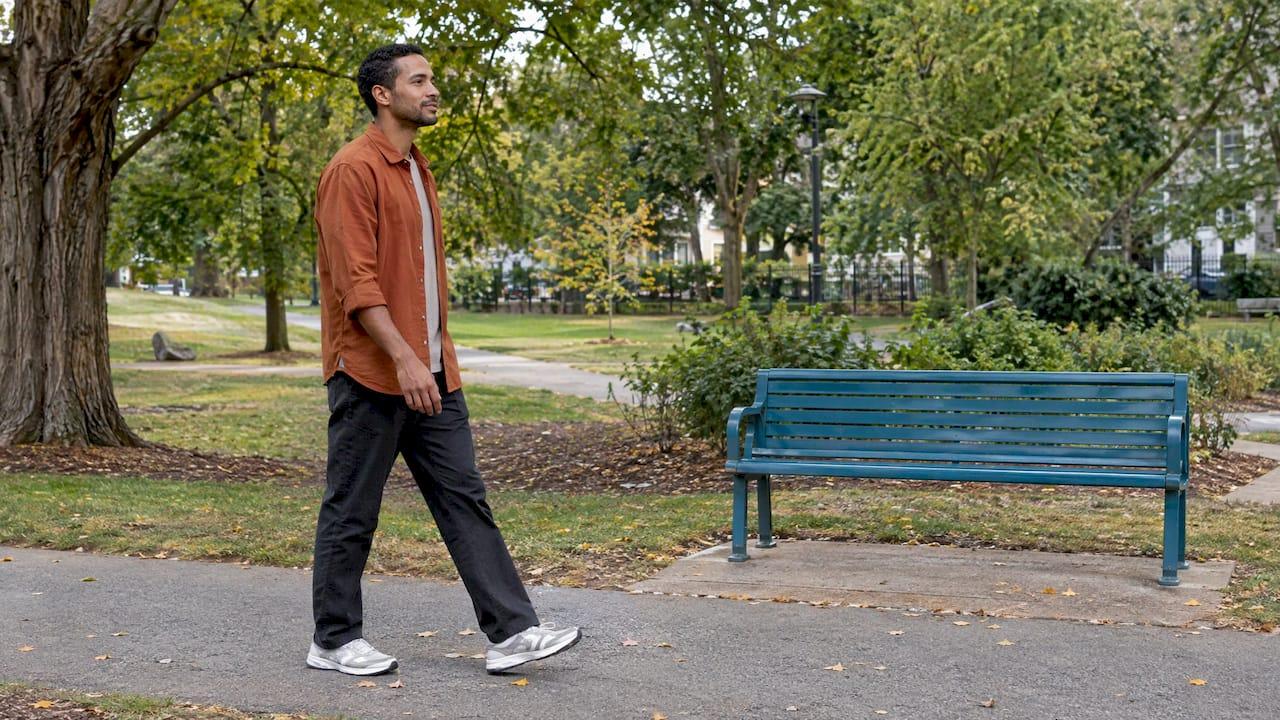
Mayo Clinic describes it as walking slowly while noticing each step, your balance, your surroundings and what you sense.
Ten minutes around the block, phone in your pocket. Feel the heel land, the weight roll forward. It is a walk with no podcast and no problem to solve.
5. Tense and release
The APA notes that actively relaxing muscles can increase energy and flexibility and leave you feeling calmer when you respond to demands.
Tighten your hands for a few seconds. Let go. Move to your shoulders, then your jaw. The contrast teaches your body what "released" feels like, which many burned-out people have forgotten.

The National Center for Complementary and Integrative Health (NCCIH) lists this, called progressive muscle relaxation, among standard relaxation techniques, alongside guided imagery and diaphragmatic breathing.
How will you know if it's working?
Not by how calm you feel in the first minute.
In the beginning, many people feel nothing. Some feel restless. That is information, not failure.
Researchers who study interoception, the ability to sense your internal signals, describe the aim as improving how you identify, access and appraise bodily signals, which may support emotion regulation and reduce distress. The same authors note that attention to the body can be hard when you are under stress, and that some people need individualized support to build it.
So watch for small shifts over a few weeks:
- You notice your shoulders climbing before the end of the day, not after.
- You catch your breath holding during an email and let it out.
- You fall asleep a little more easily, or wake a little less braced.
- You feel the "I should keep going" pull and can name it as a pull.
Noticing early is the skill. Everything else grows from it.
Where should you be careful?
These practices are gentle, but not for everyone in every moment.
NCCIH says relaxation techniques are generally safe for healthy people, and most studies report no negative side effects. Some people do report increased anxiety, intrusive thoughts or fear of losing control. In rare cases, techniques may cause or worsen symptoms in people with epilepsy, certain psychiatric conditions, or a history of abuse or trauma.
If an exercise stirs up something that feels like too much, stop. Open your eyes, look around the room, put your feet on the floor. Then talk to a licensed mental health professional or your doctor before you continue.
The same page advises seeing a healthcare provider for severe or long-lasting symptoms, and a qualified mental health professional for persistent depression or anxiety.
If you are considering yoga as your movement practice, NCCIH says it is generally safe for healthy people when done properly with qualified guidance. Sprains and strains can occur.
We are coaches, not clinicians. We do not diagnose, treat trauma or give medical advice, and nothing here replaces a doctor or therapist.

What if you do the breathing and the dread still comes back on Monday?
Then your body is telling you something true.
Picture a director, an invented composite and not a real client, who has done a breathing exercise every morning for a month. She feels calmer at 7 a.m. By 10, her calendar has eaten her again, she has said yes to two things she did not want, and her chest is tight.
The breathing is not failing her. It is doing what it can. But she is sending her body back into the same conditions every day.
Burnout rarely comes from one source. It builds in the space between what you do and what you believe you owe. It is shaped by habits of over-delivering, by identity tied to output, by a fear of being the one who lets something drop.
Body practices help you feel the cost. They do not decide what you do about it.
It is also not only personal. Workplaces carry their share, and employee engagement data gives a view of the organizational side of the same strain.
Not sure whether you are dealing with ordinary pressure or something deeper? Our guide to work stress versus burnout can help you tell.
If you want to talk it through with a person, Desert Roots Wellness offers a free Clarity Call. It is a conversation about where you are and what is draining you, nothing more.
What does a sustainable practice look like for a busy person?
Small, specific and attached to something you already do.
- Three slow breaths before you open email.
- Feet on the floor at the start of each meeting.
- A two-minute body scan when you sit down for lunch.
- A phone-free walk at the end of the day, as a boundary between work and the rest of your life.
That last one matters more than it sounds. A ritual that marks the end of work gives your body a clear signal that the day is over.
And you do not have to do it alone. The APA notes that support from colleagues, friends and family is a useful coping strategy when you feel isolated or overburdened. Tell one person what you are trying.
If you manage a team, burnout prevention is a leadership practice too. We offer Sustainable Success: Burnout Prevention for Leaders & Teams.
Why do we think the body is only half the work?
We built Desert Roots Wellness around a simple observation: many of the people who come to us look fine from the outside. They perform. They deliver. And they are running on something that has started to feel less like fuel and more like fumes.
Somatic practices matter to us because burnout is lived in the body. Slowing your breath, feeling your feet, noticing where you clench: these are real ways to come back to yourself.
But a calmer nervous system is a beginning. The deeper questions are about identity, boundaries and self-trust. Why do you say yes when you mean no? Whose expectations are you meeting? What would you choose if no one were watching?
Our coaching is built on neuroscience and trauma-informed frameworks, and on our own experience of high-stakes leadership and corporate burnout. We aim for change that lasts, not a quick fix. That is why we pair body awareness with the harder, more honest work of realignment.
If you are tired in a way that rest has not touched, that is worth taking seriously. You do not have to keep grinding through it.
Samka
Ready for more than a breathing exercise?
If you want structure, we have options at different depths.
The 30 Day Reset is a self-paced program for $297. If boundaries are where it hurts, the Boundary Starter Pack is $27, and the Clarity Kit is $37.
For private work, a single coaching session is $300, and the 90-Day Coaching Package is $2,500. Both are virtual, one-on-one. If burnout is the main thread, see our page on burnout coaching for high achievers.
Frequently asked questions
Can somatic exercises cure burnout?
Body practices are one part of recovery, not a cure on their own. The VA's National Center for PTSD says physical health practices, including stress-reducing breathing, regular exercise, sleep and nutrition, can contribute to reduced stress reactions. Pair them with changes to the workload and expectations that wore you down.
How long should I practice each day?
Start with a few minutes. Mayo Clinic suggests a few minutes of focused breathing daily, then adding time and trying other exercises until you find what suits you. Consistency matters more than length.
Do I need a therapist to try somatic practices?
Mayo Clinic Press says basic mind-body practices such as yoga, meditation and grounding are generally reasonable to practice on your own, while somatic therapy exercises may also be done with a trained therapist. If anything feels overwhelming, or you have a history of trauma, work with a licensed professional.
What if I feel worse when I try a body scan?
Stop and orient to the room: open your eyes, feel your feet, look at something nearby. NCCIH notes some people experience increased anxiety or intrusive thoughts with relaxation techniques. Speak with your doctor or a mental health professional before continuing.
Sources
- What is somatic therapy? Mayo Clinic Press
- What is somatic therapy? Harvard Health
- Self Help Physical, National Center for PTSD
- Mindfulness exercises, Mayo Clinic
- Using Relaxation Skills to Relieve Your Symptoms, Mayo Clinic
- Resources for healthcare workers, American Psychological Association
- Relaxation Techniques: What You Need To Know, NCCIH
- Mind and Body Approaches for Stress and Anxiety, NCCIH
- Interoceptive Awareness Skills for Emotion Regulation
The body keeps the score, and it also keeps the door open.