
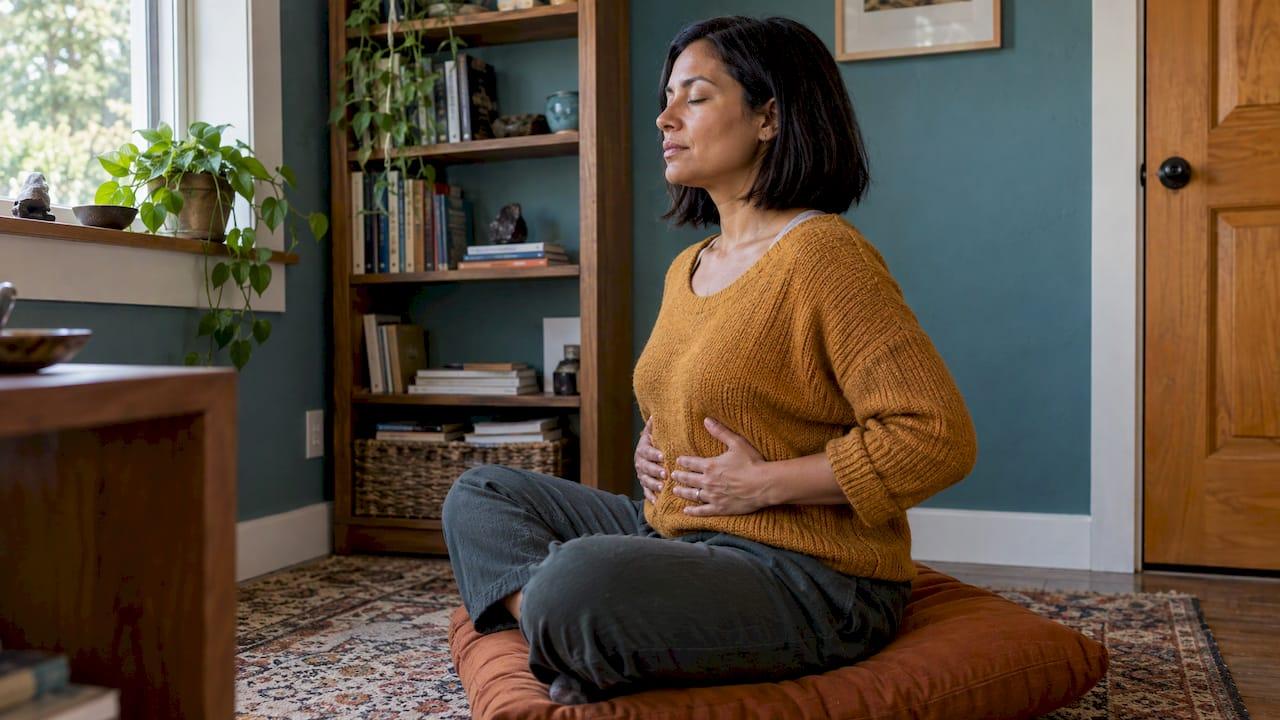
You are three emails deep into a Tuesday afternoon when you notice your jaw.
It has been clenched for an hour. Your shoulders are somewhere near your ears. Your breath is high and shallow, and you can't remember the last time it wasn't.
That is the moment somatic practices are for.
They are simple, body-first habits, like grounding, slow breathing, body scans and small mindful movements. They help you notice what stress is doing in your body and give your nervous system a chance to settle. You can do most of them anywhere, in minutes, without equipment.
Below: what they are, what the research says, five to try, how long to practice, and what to do if one of them stirs up more than you expected.
What does stress actually do to your body?
Stress is not only a thought. It is a physical state.
Mayo Clinic Press quotes a clinician describing the body's response to anxiety or trauma as labored breath, tightened muscles and activation of the sympathetic nervous system, the part that prepares you for fight or flight.
You know this state. You just may not call it that.
It is the held breath before a hard meeting. The tight chest on Sunday night. The way you can read the same paragraph four times and take in none of it.
When the pressure never lifts, the body stays braced. You keep performing, and you keep running on something that has started to feel less like fuel and more like fumes.
If you want to know whether that bracing is ordinary work stress or something heavier, our piece on how to tell work stress from burnout is a good place to sort it out. If your reactions look like fight, flight or freeze at work, that piece shows what it looks like from the outside.
What counts as a somatic practice?
The word "somatic" simply means "of the body."
Mayo Clinic Press describes somatic practices as body awareness and reflection, with purposeful, mindful movement. The examples it lists are grounding, diaphragmatic breathing, the Alexander Technique, and mindfulness exercises such as body scans, walking meditation and sitting meditation.
The goal is not reps or calories. It is attention.
Harvard Health describes somatic workouts as built from body scanning, breath awareness and micro-movements: tiny tilts, rolls or shifts done slowly enough that you can feel every phase of the motion.
That is why a somatic practice can look like almost nothing from the outside. Someone lying on a floor, barely moving, is doing real work.

Is this the same as somatic therapy?
No, and the difference matters.
Somatic therapy is an umbrella term for approaches that bring body awareness, posture, breathing or sensation into trauma care. It is delivered by trained practitioners. Mayo Clinic Press notes that therapy-level exercises may be done with a trained therapist, while basic practices like yoga, meditation and grounding are most often reasonable to do on your own.
One more line worth drawing. A breathing exercise can lower the intensity for a moment, but it is not psychotherapy and does not process a traumatic memory by itself. If you are dealing with PTSD or significant traumatic memories, a licensed mental health professional is the right person to work with.
What we are talking about here is everyday stress, the kind that builds in a demanding life. Self-guided practice fits that well.
Does any of this actually work?
Some of it has decent support. Some of it is still being studied. Both are worth knowing.
Harvard Health reports that research suggests somatic body awareness can lower cortisol, and that somatic exercise appears to reduce pain and muscle tension, calm anxiety, and improve sleep, energy and range of motion. The same article mentions a small study in which older adults in a twice-weekly online movement program moved their spines more easily after ten weeks.
Small study, modest claim. Worth holding it that way.
A 2024 systematic review in Frontiers in Psychology looked at brief body-based techniques for anxiety. It found that interventions involving active changes to the body or muscles significantly reduced state anxiety compared with control conditions, with progressive muscle relaxation showing a large effect. Breathing alone gave inconsistent results, while combination techniques that included passive attention showed consistent moderate effects.
The authors also called for more research, noting limited eligible studies.
A review of mind-body approaches for anxiety disorders found that yoga had the highest-quality data, and that these approaches are not yet recommended as primary treatments. That is a point about clinical anxiety disorders, which need proper care from a healthcare professional.
For ordinary stress, the more useful way to read all this: the body is a legitimate place to work, and variety helps. Pair breath with movement or attention rather than relying on breath alone.
Mayo Clinic also lists what relaxation techniques can do: slow your heart rate, lower blood pressure, ease muscle tension, improve sleep and mood. None of that is dramatic. All of it is the opposite of running on fumes.

Why is it so hard for high performers to slow down?
Because for you, the body has long been a delivery system for the brain.
You ask it to show up, stay sharp and push through. Rest is something you schedule after the work, if at all. When a practice asks you to lie still and feel your left shoulder, it can feel pointless, even a little irritating.
That reaction is information.
Here is a composite, not a real client. Picture a director who runs back-to-back calls and tells herself she will rest at the weekend. She tries a five-minute breathing app, feels nothing, and decides it does not work for her.
What changed things was not a better technique. It was a smaller goal: notice one place she was bracing, once, between two calls. No fixing it. Just noticing.
That is where most people need to start. Awareness comes before release.
If you want a second set of eyes on what is going on underneath the tension, we offer a free Clarity Call. It is a conversation, not a pitch, and it can help you see whether the pattern is stress, burnout or something about how you have been living.
Which somatic practices can you try today?
Pick one. Try it for a week before you add another.
- Grounding. Sit with both feet flat on the floor. Notice the pressure of your heels, the weight of your legs on the chair, the temperature of the air on your hands. Name three things you can feel. Mayo Clinic Press lists grounding among the basic practices usually reasonable to do independently.
- Belly breathing. Lie on your back with one hand on your chest and one on your stomach. Inhale slowly through your nose, keeping your chest as still as you can. Exhale slowly through pursed lips. The Mayo Clinic Press description is just that simple.
- A body scan. Move your attention through the body one part at a time and notice how each feels, without judging it. Harvard Health describes this as mentally focusing on each body part in turn. Start at your feet and end at your scalp.
- Tense and release. Work from your feet up to your head, tensing one muscle group at a time as you inhale and letting go as you exhale. This is progressive muscle relaxation, the technique the Frontiers review found to have a large effect on state anxiety.
- One slow micro-movement. Harvard Health offers an example: lying belly-down on your bed, draw one bent knee up beside your torso and slide it slowly along the bed a few inches each way. Notice how the movement ripples through your pelvis, spine, ribs and shoulder blades. Then rest and notice what feels different.
None of these need an audience, a mat or a good mood.
If you want to see what a month of daily practice could look like with some structure, our 30 Day Reset is a self-paced option at $297.
How long and how often should you practice?
Shorter than you think.
Five minutes you actually do beat thirty you keep postponing. Many people do well anchoring one practice to something that already happens: the first coffee, the end of the last meeting, the moment before bed.
Gentle shaking practices have more specific guidance. TRE Global, the organization behind tension and trauma releasing exercises, recommends that beginners limit sessions to 15 minutes and practice no more than three or four times a week, building up gradually after a few weeks.
That caution is useful for any body-based practice. More is not better. Your nervous system learns through repetition and rest, not through force.
What about people who like to optimize everything?
We see this often. A high achiever finds a practice that helps, then turns it into a metric: streaks, minutes, scores.
Notice that impulse. It is the same instrumentalizing that wore you down in the first place.
Try this instead. Ask one question after each practice: what changed, even slightly? Not whether you did it right.
What if a practice makes you feel worse?
Stop. That is a legitimate response, not a failure.
The National Center for Complementary and Integrative Health says relaxation techniques are generally considered safe for healthy people. Occasionally people report increased anxiety, intrusive thoughts or fear of losing control. There are rare reports that certain techniques may cause or worsen symptoms in people with epilepsy, certain psychiatric conditions, or a history of abuse or trauma.
Mayo Clinic's guidance is direct: if you feel emotional discomfort during a relaxation technique, stop and talk to your healthcare professional or a mental health professional.
The same goes for physical movement. Cleveland Clinic suggests you start at your current fitness level, check with your provider beforehand, and stop or adjust if something hurts.
With yoga, NCCIH notes it is generally safe for healthy people when done properly under a qualified instructor, and that people 65 and older may need to be particularly careful.
Trauma work, in particular, belongs with a licensed professional. Coaching is not a substitute for that, and we say so plainly.
What do we see when high performers try to rest?
We meet a lot of people who are good at everything except stopping.
They arrive with a full toolkit: apps, breathing techniques, a stretching routine they abandoned in March. The tools are fine. What is missing is the reason they can't use them.
Usually it is that the body became a means to an end. You learned early that worth comes from output, so slowing down feels unsafe, or lazy, or both.
That is why we don't treat somatic practice as a trick to calm you down so you can work more. Our approach draws on neuroscience and trauma-informed frameworks, and it aims at lasting change rather than symptom management. The body is one of the places where you start to hear what you need.
The practices in this article are a real start. Doing them alongside honest questions about boundaries, expectations and what you are working toward is where things shift. That is the work we do with clients, and it is built from our own experience of high-stakes leadership and burnout.
Samka
Ready for more than a five-minute fix?
If you want guided structure, we have a few ways in.
The Boundary Starter Pack is $27, and the Clarity Kit is $37. Both are self-paced downloads for when stress comes from saying yes too often or not knowing what you want.
For one-on-one support, the Single Coaching Session is $300, and the 90-Day Coaching Package on the same page is $2,500. Sessions are virtual, so where you live doesn't matter.
If your stress mostly shows up as worry, the Anxiety Blueprint is another place to look. If you lead a team, our burnout prevention training for leaders and teams is built for that.
Frequently asked questions
Can I do somatic exercises for stress on my own?
For everyday stress, usually yes. Mayo Clinic Press says basic practices like yoga, meditation and grounding are most often reasonable to do independently. If you are dealing with PTSD or significant traumatic memories, work with a trained practitioner instead. Yahoo Health makes the same distinction.
What is somatic stress release?
It is the idea that stress is held in the body as tension, and that body-based practices can help you let some of it go. Common examples are body scans, grounding, breathwork, slow movement and gentle shaking. The research is still developing, so treat it as a supportive practice, not a cure.
How quickly will I feel something?
Some people feel calmer within a single session. Others feel very little at first, which is common when you are used to ignoring your body. Give one practice a week of daily attempts before you judge it.
Is somatic work a replacement for therapy or medical care?
No. It is a complementary practice. If stress is affecting your sleep, health or ability to function, speak with a doctor or licensed mental health professional.
The tight jaw was never the problem. It was the message.
Sources
- What is somatic therapy? Mayo Clinic Press
- What are somatic workouts? Harvard Health
- Somatic Therapy for Trauma: Evidence and Limits
- A systematic review of brief respiratory, embodiment and related interventions, Frontiers in Psychology
- Mind-Body Interventions for Anxiety Disorders: A Review
- Relaxation techniques: Try these steps to lower stress, Mayo Clinic
- Mind and Body Approaches for Stress and Anxiety, NCCIH
- Frequently Asked Questions, TRE Global
- Somatic workouts and exercises, Cleveland Clinic
- What Are Somatic Exercises? Yahoo Health