

Burnout recovery is defined as the process of restoring physical, emotional, and cognitive function after chronic workplace or life stress has depleted your reserves. The burnout recovery timeline varies widely by severity: mild cases improve in 2–12 weeks, moderate to severe burnout takes 3–6 months, and chronic burnout can require 1–3 years of sustained effort. Recovery is rarely linear, and it never happens by simply waiting it out. The root causes, the environmental stressors, the identity patterns, and the habits that drove you to empty in the first place, all need to change permanently. That is the part most people skip, and it is why so many high performers relapse.
What are the stages of burnout recovery?
A five-stage recovery process typically spans 3–12 months and moves through crisis recognition, stabilization, energy auditing, values realignment, and sustainable rebuilding. Each stage has a distinct focus. Rushing through any one of them does not speed up healing. It delays it.
Stage 1: Crisis recognition (weeks 1–4)
This is the moment you stop pretending you are fine. Your body has likely been sending signals for months: disrupted sleep, persistent irritability, physical fatigue that no amount of rest seems to fix. Acknowledging that you are burned out, not just tired, is the first real act of recovery. Many high achievers resist this stage because it feels like admitting defeat. It is not. It is the only honest starting point.
Stage 2: Stabilization (months 1–3)
Your nervous system needs to stop running on emergency mode before anything else can work. Nervous system regulation is a prerequisite for effective cognitive and mindset recovery. That means prioritizing sleep, nutrition, and sensory regulation above productivity goals. Mental fog and cognitive decline are common during this phase. Do not try to think your way out of burnout while your brain is still in crisis.

Stage 3: Energy audit and boundary redesign (months 3–6)
Once you are stabilized, you can start examining what actually depleted you. An energy audit means mapping where your time and attention go and identifying which commitments drain you without returning anything meaningful. This is where boundary redesign happens. Not vague boundary-setting, but specific structural changes: fewer meetings, protected recovery time, renegotiated workloads.
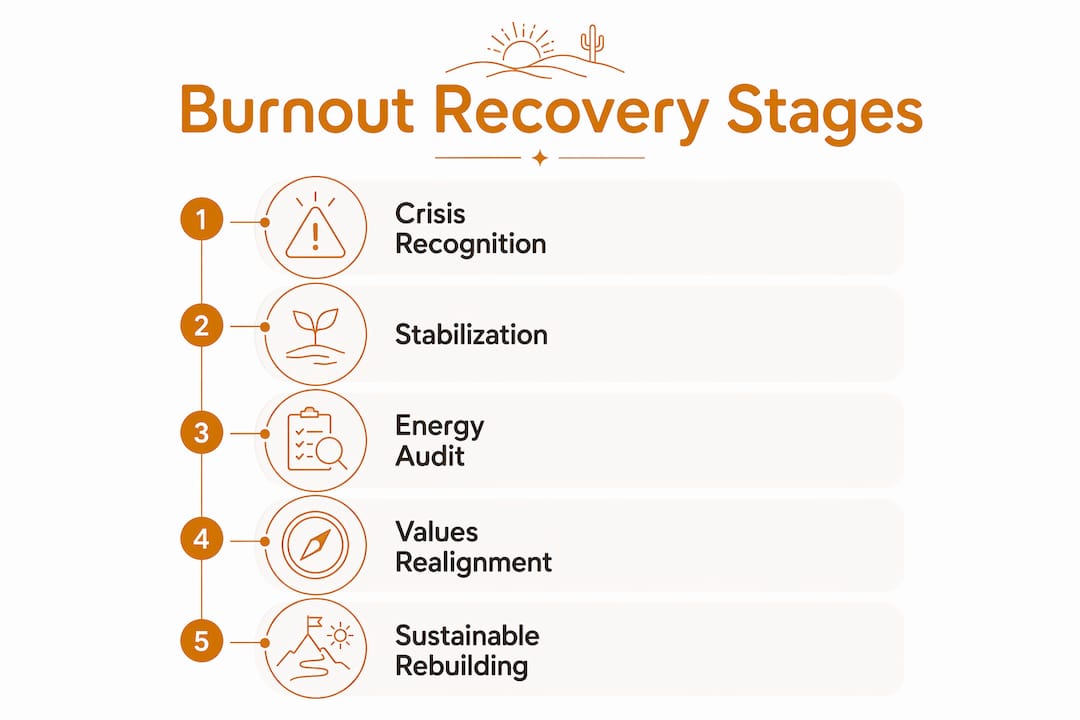
Stage 4: Values realignment (months 3–6)
Burnout often signals a deep misalignment between what you are doing and what you actually value. This stage asks harder questions. Are you chasing goals that were never really yours? Have you outsourced your sense of worth to external metrics? Values realignment is not a weekend retreat exercise. It is a slow, sometimes uncomfortable process of reconnecting with what genuinely matters to you.
Stage 5: Sustainable rebuilding (months 6–12+)
This is where you build new patterns that can hold under pressure. Re-engagement with work and responsibilities happens gradually, not all at once. The goal is not to return to who you were before burnout. That version of you burned out. The goal is to build something more sustainable.
Pro Tip: Track your energy levels daily during stages 2 and 3 using a simple 1–10 scale. Patterns emerge within two weeks and give you real data for your energy audit.
| Stage | Focus | Typical Timeframe |
|---|---|---|
| Crisis recognition | Acknowledge burnout and stop accumulating new stress | Weeks 1–4 |
| Stabilization | Sleep, nutrition, nervous system regulation | Months 1–3 |
| Energy audit | Identify drains, redesign boundaries | Months 3–6 |
| Values realignment | Reconnect with authentic priorities | Months 3–6 |
| Sustainable rebuilding | Gradual re-engagement, new patterns | Months 6–12+ |
How do severity and external factors affect the recovery timeline?
Recovery speed depends heavily on what you are recovering inside and what you are returning to. These are two separate problems, and both require attention.
Burnout severity sets the floor for how long healing takes. Mild burnout, where you feel depleted but still functional, can resolve in weeks with the right rest and adjustments. Moderate to severe burnout, where motivation has collapsed and emotional detachment has set in, takes months. Chronic burnout, the kind that has been building for years, often requires a full lifestyle restructuring that can span 1–3 years.
Environmental factors are where most recovery plans fail. Without removing underlying triggers, people stall or relapse within 3–6 months even with professional support. Returning to the same workload, the same toxic dynamics, or the same boundary-free schedule undoes progress faster than almost anything else. Permanent structural changes to workload and control are not optional. They are the recovery.
"Rest alone is insufficient. Restorative rest, combined with fundamental shifts in values and environment, is what real recovery requires. The same toxic environment leads to repeated depletion cycles."
Professional support, whether therapy or coaching, can shorten the healing process. But it only works if the root causes are also changing. Support without structural change is like patching a tire that keeps running over the same nail.
- Mild burnout: 2–12 weeks with rest and boundary changes
- Moderate to severe burnout: 3–6 months with professional support and environmental shifts
- Chronic burnout: 1–3 years requiring full lifestyle restructuring
- Setbacks are normal and do not reset the clock entirely
- Restorative rest differs from vacation. It includes emotional, social, and sensory recovery.
Pro Tip: Before returning to full work capacity, ask yourself honestly: has the environment changed, or just your attitude toward it? If only your attitude has changed, relapse is likely.
What practical strategies support sustainable burnout recovery?
Recovery is not passive. It requires deliberate choices at each stage, and those choices need to match where you actually are in the process, not where you wish you were.
Prioritize physiological needs first
Physiological needs must come first. Cognitive and emotional strategies only succeed after nervous system stabilization. That means sleep is non-negotiable in early recovery. Nutrition matters. Reducing sensory overload, constant notifications, overscheduled days, creates the conditions your nervous system needs to downregulate. You cannot reframe your mindset when your body is still in fight-or-flight.
Conduct a personal energy audit
An energy audit is a structured review of where your attention, time, and emotional resources go each day. Write down every commitment, every recurring obligation, and every relationship that demands energy. Then ask which ones return something meaningful. The ones that do not are candidates for reduction or elimination. This is not about becoming selfish. It is about becoming sustainable.
Seek support without waiting until you are desperate
Early intervention prevents progression to more severe burnout. Therapy, coaching, and peer support all reduce recovery time when accessed early. The professionals who tend to wait longest for help are often the ones who pride themselves on self-sufficiency. That pride is part of what drove the burnout in the first place.
Adopt a "good enough" mindset
Perfectionism in recovery creates additional burnout patterns and frustration. Self-imposed timelines for healing add pressure that actively slows progress. "Good enough" is not a lowered standard. It is a recalibrated one that accounts for where you actually are. Progress that is slow and consistent beats progress that is fast and unsustainable.
- Sleep 7–9 hours consistently, not just on weekends
- Eat regular meals without skipping to "save time"
- Reduce screen time and notification load during early recovery
- Set one boundary per week and hold it, even when it feels uncomfortable
- Re-engage with work gradually, starting at reduced capacity
- Build in weekly recovery time as a non-negotiable, not a reward
Pro Tip: Schedule recovery activities the same way you schedule meetings. If they are not on the calendar, they will not happen.
What are the biggest misconceptions about burnout healing?
The most damaging misconception is that rest cures burnout. A vacation does not fix burnout. Rest alone is insufficient. Restorative rest, which includes emotional and social restoration alongside physical rest, is different from simply taking time off. You can spend two weeks on a beach and return to the same depleted state within days if nothing structural has changed.
The second misconception is that burnout reflects personal weakness. Burnout is a natural response to chronic, unsustainable demands, not a character flaw. High performers are particularly vulnerable because their capacity to push through discomfort is exactly what makes them effective and exactly what makes them ignore early warning signs. "Powering through" worsens severity and makes recovery harder.
Physical recovery timelines also surprise people. Acute symptoms like exhaustion and irritability may ease within weeks. Full neurological and cognitive healing takes considerably longer. Memory issues, difficulty concentrating, and emotional flatness can persist for months into recovery. These are not signs that you are failing. They are signs that your brain is still healing.
- Myth: A vacation will fix burnout. Reality: Restorative rest requires structural change, not just time away.
- Myth: Burnout means you are weak. Reality: It is a predictable response to chronic overload.
- Myth: Once you feel better, you are recovered. Reality: Relapse risk is high without addressing systemic causes.
- Myth: Cognitive symptoms clear up quickly. Reality: Mental fog and memory issues can persist for months.
- Myth: Powering through speeds recovery. Reality: It deepens the depletion and extends the timeline.
Key Takeaways
Burnout recovery requires permanent changes to root causes, not just rest, and typically spans 2 weeks to 3 years depending on severity and whether the underlying environment changes.
| Point | Details |
|---|---|
| Timeline varies by severity | Mild burnout resolves in 2–12 weeks; chronic cases can take 1–3 years. |
| Five stages guide recovery | Progress moves from crisis recognition through stabilization, auditing, realignment, and rebuilding. |
| Environment must change | Returning to unchanged conditions causes relapse within 3–6 months, even with support. |
| Physiological needs come first | Sleep and nervous system regulation must precede cognitive or mindset work. |
| Perfectionism slows healing | Accepting "good enough" progress is healthier and more sustainable than self-imposed timelines. |
What I have learned about trusting the timeline
I have watched this process up close, in myself and in the professionals I work with at Drwmbs. The hardest part is not the exhaustion. It is the grief. Grief during early recovery is normal and signals healing, not failure. You are grieving the identity you built around constant output. That grief is real, and it deserves space.
What I have found is that the people who recover most fully are not the ones who push hardest through the process. They are the ones who get honest about what needs to change externally, not just internally. Burnout is not a you problem. It is a you-plus-your-environment problem. Fixing only yourself while returning to a broken system is not recovery. It is preparation for the next collapse.
The timeline is also deeply personal. Comparing your month three to someone else's month three is a trap. Your nervous system, your history, your circumstances, all of it shapes how long this takes. What matters is that the direction is forward, even when the pace feels impossibly slow. Small, consistent improvements compound. They always do.
— Samka
Support that meets you where you are in recovery
Knowing the stages of burnout recovery is one thing. Having the right support to move through them is another.

At Drwmbs, Samka Keranovic and Tyler LaBarge work with high-performing professionals who are ready to do more than just rest. The approach integrates neuroscience and trauma-informed coaching to address the root causes of burnout, not just the symptoms. If you are somewhere in the middle of this process and feel like you are spinning without traction, personalized coaching support at Drwmbs is built for exactly that moment. Recovery does not have to be a solo effort.
FAQ
How long does burnout recovery typically take?
Burnout recovery ranges from 2–12 weeks for mild cases to 1–3 years for chronic burnout. The timeline depends on severity, whether root causes are addressed, and the quality of support available.
What are the first signs that burnout recovery is working?
Early signs of recovery include improved sleep quality, reduced emotional reactivity, and the gradual return of motivation for activities you previously enjoyed. These shifts often appear first in physical symptoms before cognitive clarity returns.
Can you recover from burnout without changing jobs?
Yes, but only if the work environment itself changes. Without permanent structural changes to workload, autonomy, and boundaries, returning to the same conditions typically leads to relapse within 3–6 months.
Why does burnout recovery feel non-linear?
Recovery is non-linear because healing involves multiple systems, neurological, emotional, and behavioral, that do not all improve at the same rate. Setbacks during recovery are normal and do not erase prior progress.
Does therapy speed up the burnout recovery process?
Professional support like therapy or coaching can shorten recovery time, but only when combined with real changes to the underlying environment. Support without structural change addresses symptoms without resolving the cause.